The question
I replaced the dense FFN in a 12-layer LLM with a from-scratch MoE layer: a router, top-k expert selection, and a load-balancing auxiliary loss. I went in with three hypotheses:
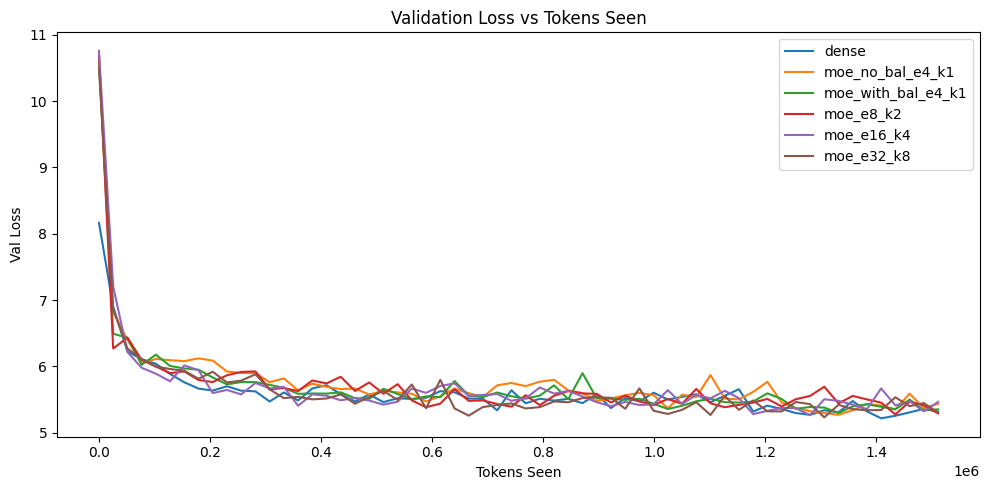
- MoE converges faster than the dense model at the same active parameters.
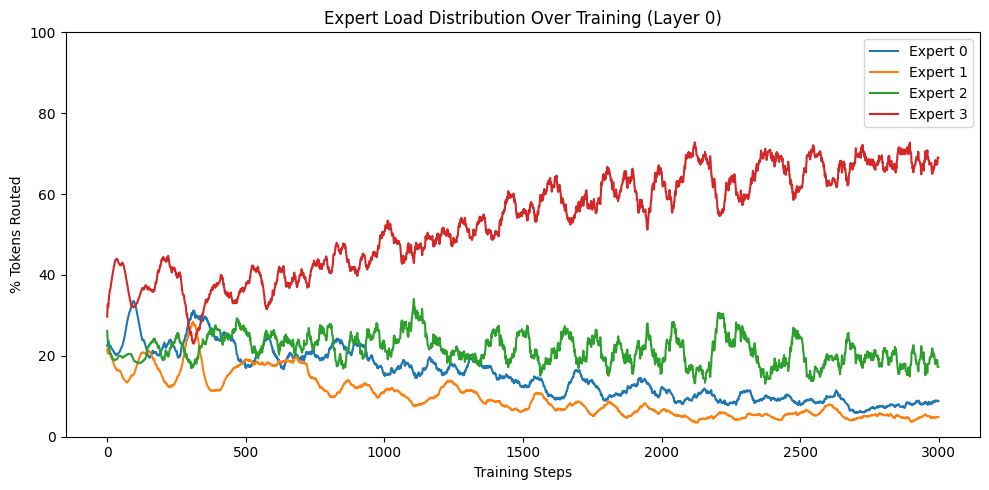
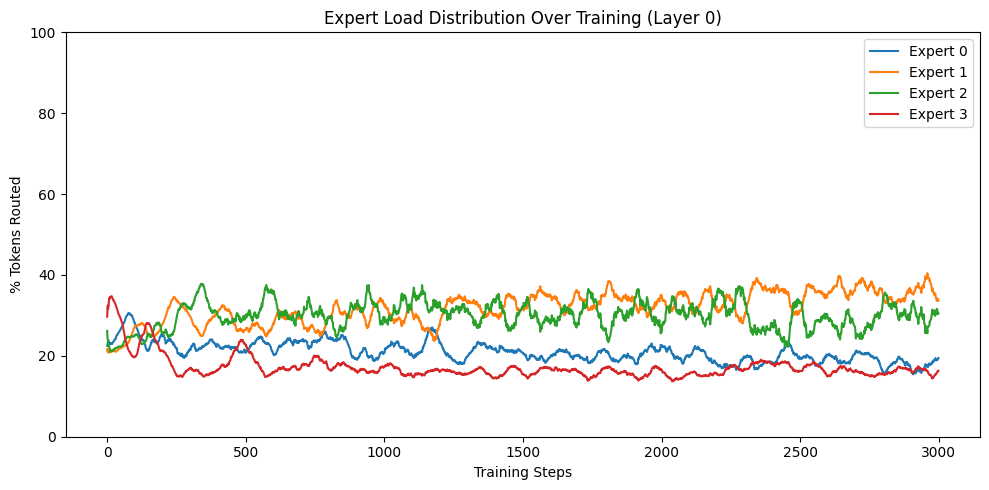
- The load-balancing loss spreads tokens evenly across experts; without it, a few experts dominate.
- More, finer-grained experts (4, 8, 16, 32 at proportionally smaller hidden dims, same active parameters) converge faster.
Setup
12 layers, embedding size 768, sequence length 256, trained on 768k tokens of Project Gutenberg text. Dense and MoE variants trained under the same budget.
Results
Only hypothesis 2 survived.
- Without the auxiliary loss, expert 3 swallowed most tokens, climbing to around 70% of routing. With it, tokens spread across all four experts.
- MoE did not converge faster than dense, despite carrying more total parameters.
- All fine-grained configurations, from 4 to 32 experts, produced nearly identical loss curves.
What I learned
Two of my three hypotheses failed, and the likely reason is scale. The results I was testing against come from runs on billions of tokens; at 768k tokens there is little room for experts to specialize. The experiment cleanly separated what held (the routing mechanism behaves as theory predicts) from what did not transfer down to small scale (the convergence and fine-graining benefits).