Setup
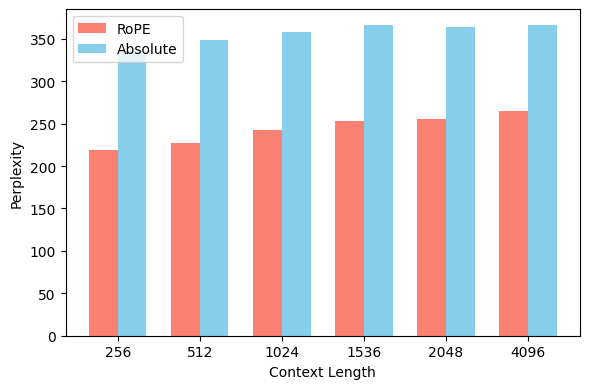
Two identical GPT-2 style models, one with RoPE and one with learned absolute position embeddings, trained on 13 Project Gutenberg books (768k tokens) at sequence length 256. Then evaluated at context lengths out to 4096, sixteen times the training length.
Results
| Context length | RoPE perplexity | Absolute perplexity |
|---|---|---|
| 256 | 218.5 | 335.0 |
| 512 | 227.3 | 348.7 |
| 1024 | 242.5 | 358.2 |
| 2048 | 255.2 | 364.3 |
| 4096 | 265.1 | 366.8 |
RoPE produced lower perplexity at every length tested.
What I learned
The surprise was the absolute-embedding curve. Its position table is sized for 4096 but only ever trained at 256, so positions beyond 256 were untrained, and I expected perplexity to blow up once the model was pushed past the training length. It did not: the curve flattened near 365 instead of climbing. So this run says RoPE is better at every length I tested, but the specific extrapolation failure I built the test for did not reproduce at this scale.