The question
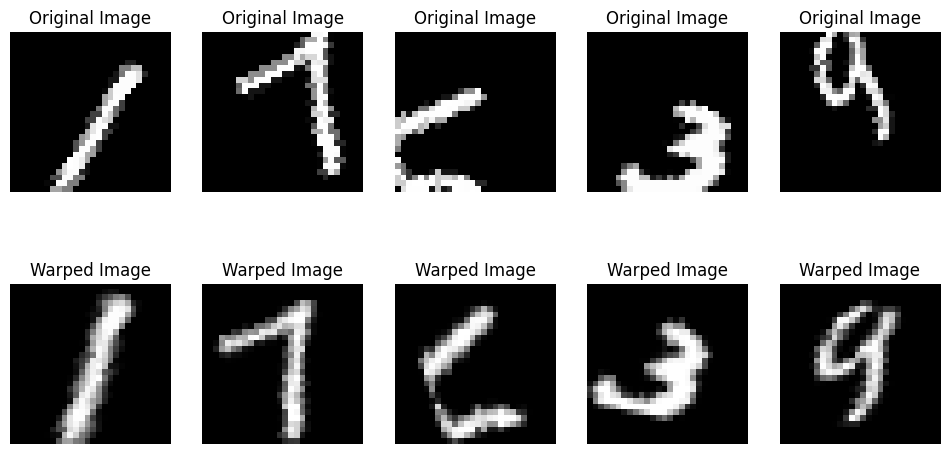
A CNN is translation equivariant, but equivariance is not invariance. In practice we lean on data augmentation and max-pooling, and both only cover distortions close to what training saw. A Spatial Transformer Network takes a different approach: a small localisation network predicts an affine transform and warps the input into a canonical pose before the classifier sees it, learned entirely from the classification loss with no pose labels.
So there are really two questions here: how far does that robustness actually stretch as the input gets harder, and what does the localisation network end up learning to do?
Setup
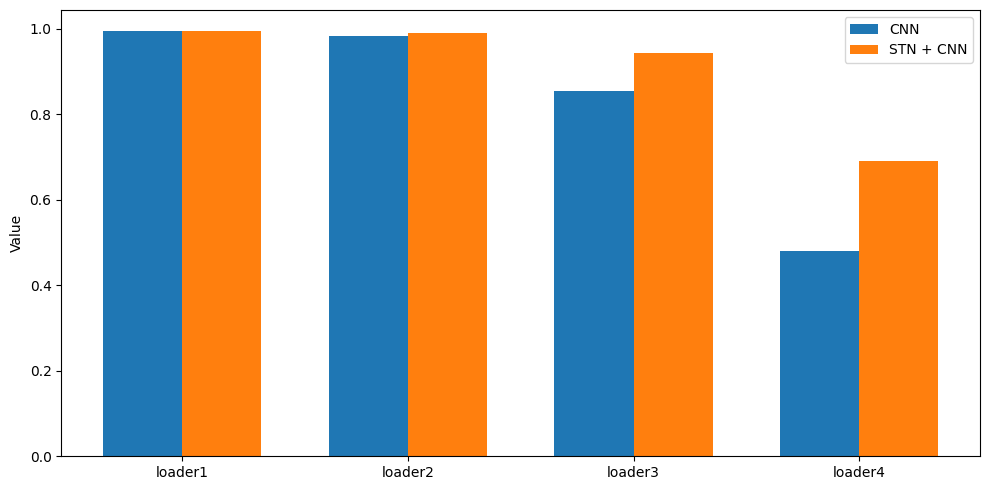
MNIST, the same CNN backbone and hyperparameters (20 epochs, Adam, lr 0.001, batch 64) with and without an STN in front. Four test sets with escalating geometric distortion: clean, moderate (±20° rotation), high (±40°), extreme (±60°), with matching translation and scale ranges. Training used 40% random moderate augmentation.
Results
| Test set | CNN | STN + CNN | Delta |
|---|---|---|---|
| Clean | 99.41% | 99.44% | +0.03 pp |
| Moderate | 98.32% | 99.01% | +0.69 pp |
| High | 85.42% | 94.43% | +9.01 pp |
| Extreme | 47.92% | 69.20% | +21.28 pp |
What I learned
On clean data the STN adds nothing, and that is the point: the advantage grows with distortion, from +0.03 percentage points on clean MNIST to +21.28 under extreme distortion. The warped outputs show what the STN learned to do: center shifted digits, rescale them, and partially correct rotations it never saw in training.